Wednesday, February 27, 2008

IME Night Showcases Programs with Facts, Fun, and Food

To showcase IME’s four undergraduate programs, the IME department held its second annual IME Night. IME students and professors provided lots of pizza in an informal setting to discuss and answer questions about industrial and entrepreneurial engineering (IEE), manufacturing engineering technology (MFT), engineering management technology (UEM), and engineering graphics and design technology (EGR).
clip_image002

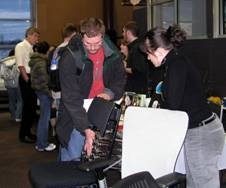
Ilgin Acar (right), IE Ph.D. student, reviews chair research with Case Bonebrake, who came to IME Night to explore options and who won the
door prize, a WMU chair.

Slobodan Urdarevik, IME faculty, coordinated the event. Activities included games, lab tours, research displays, and networking opportunities with faculty, students, and representatives of two area companies Enhancing the fun was a variety of pizza, soda, and treats.
 

clip_image004
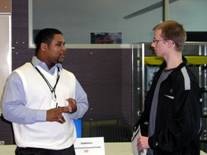
Torrey Cook (left), associate human resource manager for General Foods’ Post Cereal, talks to Wes Moon, an undecided CEAS student. Post is a major
contributor to WMU and CEAS.

Torrey Cook, an associate human resource manager for General Foods’ Post Cereals, and Anton Lorentz III, a technology team leader from Parker Hannifin Corp., the Parker Aerospace Group, The Hydraulics System Division, discussed what engineers do in the workplace. Cook also answered questions of presently enrolled IME students about resumes and life after graduation.
clip_image006
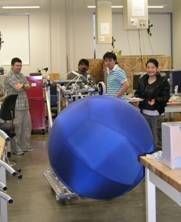
As Trent Kenworthy (left), an IME teaching assistant majoring in IE,
looks on, IME professor Dr. Tarun Gupta (second from left) explains a
robot to two undecided students who attended IME Night. The robot
was designed and built by a team of area high school students for the
2008 FIRST regional competition next month.

IME students and faculty set up tables to showcase IME programs, products, and organizations and to answer questions. Ongoing chair research being done by IME’s Human Performance Institute was displayed so that participants could examine a chair used to produce computerized images of the pressure points a person exerts when he or she sits. Furthermore, some Parkview Campus engineering labs were open for guided tours and demonstrations

clip_image008

IME faculty Dr. Tarun Gupta (left) and Slobodan Urdarevik, discuss
IME programs with Kevin Megee (right), an undecided CEAS engineering student. Urdarevik coordinated IME Night.

Urdarevik credited the IME professors, staff, and students for the event’s success. Special thanks were offered to Troy Place, who emailed over 160 invitations, Fred Sitkins, who invited the corporate representatives, and the IME office staff: Klaz Welch, Mary Fosburg, Marji VanHoorelbeke, and John Jacobs for their efforts in procuring food and preparing publicity materials. “Many contributed to this event,” Urdarevik said.

Tuesday, July 17, 2007

Casting Spells with High School Students at Summer Workshop

Last month, IME professor Dr. Sam Ramrattan hosted a weeklong metal-casting workshop for nine high school students from areas around Detroit, Ann Arbor, and Saginaw, Michigan; Cleveland, Parma, and Defiance, Ohio; and Windsor, Ontario. He has been offering the annual hands-on workshops for up to 15 area tenth-through-twelfth-grade students for the last eight summers.

clip_image002

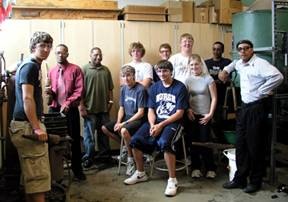
Dr. Sam Ramrattan (right) and Adil Abdelwahab (second from right in back), an IME graduate student, pose with nine high school students who attended the 2007 summer metal casting short course at WMU

During the students’ five-day campus visit, Ramrattan, a technical advisor to the American Foundrymen's Society and a Key Professor for the Foundry Educational Foundation, directs activities in the College of Engineering and Applied Sciences, Parkview Campus Metal Casting Laboratory.

Workshop topics include metal casting history, trends, and the relationship of manufacturing (molding, melting, filling, and finishing), engineering, quality, purchasing, marketing, and sales of castings. The students explore the use of computers, math, and science in metal casting.

In addition to their lab and course work, the students meet with WMU administrators to discuss university entrance requirements and expectations and with professionals from the foundry industry to review career opportunities in metal casting.

Field trips to metal casting industries provide students with opportunities to see real-world technology and to meet with professionals. This year’s attendees toured Metal Technologies’ Three Rivers Gray Iron Plant, and Contech’s die casting facilities in Dowagiac, MI. They also enjoyed activities in the Kalamazoo / Portage metro area.

Students who attend the program are sponsored by various chapters of the American Foundry Society (AFS) and the North American Die Casting Association (NADCA). Students are selected on the basis of an aptitude for math and science. There is no cost to the students, who stay in WMU dorms and enjoy campus life.

clip_image004

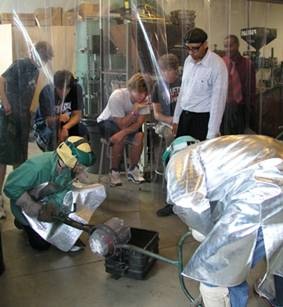
Dr. Sam Ramrattan supervises as two students pour molten aluminum into sand molds that they had prepared. Other high school students, seated behind the protective barrier, took turns donning safety apparel and making their own sand castings.

WMU has had a casting metal program in various engineering curricula since the college opened over 100 years ago. Its most recent accreditation began in 1992 when Ramrattan joined the faculty. It is currently an option in all IME undergraduate programs. “Our goal is to produce hands-on engineers as an integral part of what we do in manufacturing engineering programs,” he said.

clip_image006

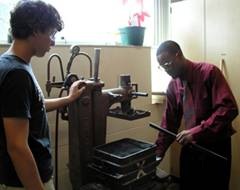
Saginaw high school students Steve Trombley (left) and Rollin Carter prepare a sand mold that they will use to create sand castings from molten aluminum.

Ramrattan specializes in material and process improvement emphasizing casting and non-traditional manufacturing processes. For more information, contact him at sam.ramrattan@wmich.edu

Tuesday, July 3, 2007

ANTEC Offers Fun and Futuristic Visions of the World of Plastic

Five members of WMU’s student chapter of the Society of Plastics Engineering (SPE) attended the society’s Annual Technical Conference (ANTEC) in Cincinnati, OH, in May. WMU Engineering Graphics and Design Technology (EGR) seniors Josh Leyrer, Jim Gabriel, Courtney Rawlings, Lauren Lambert, and Jim Vlieg were accompanied by IME Department Chair Paul Engelmann and Jay Shoemaker, IME adjunct professor and Moldflow, Inc., employee.

ANTEC, the world’s largest plastics conference, included four days of technical presentations covering all concentrations of the plastics engineering field. “I’m really interested in plastics, and this conference was THE conference for plastics,” Lambert said. “We learned about plastics from many perspectives.”

Presentation topics included process optimization methods, overcoating improvements, bioplastics, shear-thickening fluids, the Boeing 787 Dreamliner, and nanotechnology. Presenters included university professors, research and industrial professionals from all over the world.

Vlieg enjoyed the “especially interesting” presentation on bioplastics. “With oil prices rising, plastics derived from other sources could be the future of the industry,” he said. Lambert was “wowed” by the presentation on nanocomposities. “I would really like to learn more about them and their potential,” she said.


clip_image002

Five WMU students attended ANTEC student activities night, which included two hours of games. At right, WMU students (from left) Jim Gabriel, Jim Vlieg and Lauren Lambert. enjoy virtual bowling. “We had two hours of any game we wanted to play,” Lambert said. In addition Gabriel won a pair of Oakley sunglasses in a raffle.

Students learned about the latest technologies and developments in plastics at Plastics Encounter, an exhibition set up by plastics companies.


clip_image004

WMU SPE group enjoy an ANTEC networking social. From left, clockwise: Dr. Paul Engelmann, Lauren Lambert, Josh Leyrer, Jay Shoemaker, Courtney Rawlings, Jim Vlieg, and Jim Gabriel.


Evenings included several social events. Formal and informal socials gave the students and professors opportunities to form networking connections with others in the industry. One evening also included a Moldflow-sponsored student activities night at a local gaming center.

Students were selected for the trip based on individual application essays. They wrote formal proposals for travel support to the conference as well as trip reports on their ANTEC activities and professional development upon their return.

"I'm glad that I was given the opportunity to go to this event to further my learning in the plastics field," Rawlings said.

The trip was sponsored in full by a grant for support of lifelong learning and supplied to the school by the Alcoa Foundation, through EPC/Alcoa in Mattawan. The grant supports the professional development and global awareness of students in engineering technology programs.

Dr. Betsy Aller, IME associate professor, is principal investigator of the grant.