Tuesday, August 29, 2006

IME Group Enjoys ANTEC’s Futuristic Perspective of Plastics

Last May, 11 IME professors, graduate assistants, and students joined up to 5,000 plastics enthusiasts from all over the world at the Annual Technical Conference (ANTEC) sponsored by the Society of Plastics Engineers (SPE) and held in Charlotte, NC.

Described on the SPE Web site as “the leading technical forum for providing cutting-edge technological issues and information pertinent to the needs of the plastics industry,” ANTEC annually offers peer-reviewed technical papers providing plastics professionals “unique inside access to proprietary research and findings.”

IME Chair Dr. Paul Engelmann called ANTEC “the major technical event for plastics.” He said that more than 600 papers were presented in 25 concurrent sessions that ran from 8 a.m. to 6 p.m. for three days and for most of a fourth. “The Society’s best international papers for the year are presented at this set of meetings,” he said.

Accompanying Engelmann were IE Ph.D. graduate assistants Kurt Hayden and Jason Trahan; Jay Shoemaker, adjunct assistant professor from Moldflow; and Brian Sather, a master’s candidate graduate assistant in the plastics manufacturing program.

The six undergraduate students who attended – Brian Cervin (MFT), Andrew Dowdy (EGR), Greg Giudici (EGR), John Graver (MFT), Eric Korbecki (EGR), and Ryan Miller (MFT) – served as ushers at technical sessions in lieu of registration fees. The undergraduate students’ travel arrangements were made by Hayden, who also mentored the students throughout the conference.

Funds to send the students to the conference were provided by a grant from the Alcoa Foundation, through EPC/Alcoa in Mattawan. The grant supports the professional development and global awareness of students in engineering technology programs. The students wrote formal proposals for travel support to the conference as well as trip reports on their ANTEC activities and professional development upon their return.

IME Assistant Professor Dr. Betsy Aller is principal investigator of the grant and Professor Dr. Larry Mallak is co-PI. Aller has applied for another EPC/Alcoa grant for the same purpose; it is currently in the process of being approved at the national level.

Trahan presented a paper titled "Why troubleshoot when you can prevent? A Bayesian network approach," which he described as his ”biggest event” of the conference. “I had good turnout for the presentation and good conversations afterwards on the topic,” he said.

In addition to the papers, the event also included a series of special international panels and vendor displays.

The attendees were particularly impressed by the panel discussions, especially one titled “The Plastics Industry in India: The Next Frontier.” Engelmann said, “It furthered my understanding of the maturity of that industry in India as compared to in the US.” Engelmann was also impressed by presentations on nanotechnology, which could revolutionize the way that reinforcing elements are used in plastics.
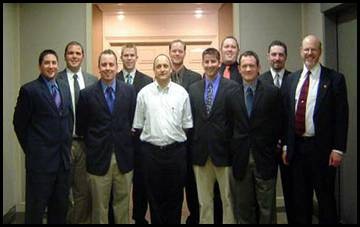
Attending ANTEC: (FRONT L-R) Brian Cervin, Andrew Dowdy, Jay Shoemaker, Brian Sather, Kurt Hayden, and Dr. Paul Engelmann. (BACK L-R) Greg Giudici, Eric Korbecki, Jason Trahan, John Graver, and Ryan Miller.

Attending ANTEC: (FRONT L-R) Brian Cervin, Andrew Dowdy, Jay Shoemaker, Brian Sather, Kurt Hayden, and Dr. Paul Engelmann. (BACK L-R) Greg Giudici, Eric Korbecki, Jason Trahan, John Graver, and Ryan Miller.

The IME students attending ANTEC cited presentations on globalization in the plastics industry and an interactive session on injection molding as among the most interesting and useful sessions. They also noted that many sessions helped them see the relevance of and connections between materials they’d learned in classes.

Several attendees mentioned “Student Recognition Night,” sponsored by several companies including Moldflow, as a fun social activity. Students played arcade games, networked with professionals and attendees from other universities, and received free SolidWorks software.

In their trip reports, students said that the opportunity to travel and interact with IME professors and graduate students was excellent, as was networking with other students and professionals at ANTEC. “After participating in the ANTEC conference, I see that there are so many different directions that the plastics industry has to offer,” Cervin said. “Only at a convention of this magnitude can you appreciate [all these aspects].”

Several students stated they were inspired to present a professional paper at a future ANTEC conference. And all echoed Dowdy’s “Thank you for the continued support and development of engineering students!”

With support from the new EPC/Alcoa grant, IME plans to send several undergraduate students to ANTEC 2007, with the goal of presenting at least one technical paper.

Thursday, July 27, 2006

Metal Casting Workshop Sparks Interest of Area High School Students

clip_image002

Dr. Sam Ramrattan explains the metal casting process to high school students enrolled in the 2006 summer metal casting workshop

Last month, IME professor Dr. Sam Ramrattan hosted a weeklong metal-casting workshop for 10 high school students from Kalamazoo, Coldwater, Saginaw, Grand Rapids, Detroit, and Toledo, Ohio. He has been offering similar hands-on workshops for up to 15 area tenth-through-twelfth-grade high school students during each of the last seven summers.

During the students’ five-day campus visit, Ramrattan, a technical advisor to the American Foundrymen's Society and a Key Professor for the Foundry Educational Foundation, directs activities in the College of Engineering and Applied Sciences, Parkview Campus Metal Casting Laboratory.

Workshop topics include metal casting history, trends, and the relationship of manufacturing (molding, melting, filling, and finishing), engineering, quality, purchasing, marketing, and sales of castings. The students explore the use of computers, math, and science in metal casting.

In addition to their lab and course work, the students meet with WMU administrators to discuss university entrance requirements and expectations and with professionals from the foundry industry to review career opportunities in metal casting.

Field trips to metal casting industries provide students with opportunities to see real-world technology and to meet with professionals. This year’s attendees toured A.C. Foundry in Battle Creek, MI, Metal Technologies’ Three Rivers Gray Iron Plant, and SPX Contech’s die casting facilities in Dowagiac, MI. They also enjoyed activities in the Kalamazoo / Portage metro area.

Students who attend the program are sponsored by various chapters of the American Foundry Society (AFS) and the North American Die Casting Association (NADCA). Students are selected on the basis of an aptitude for math and science. There is no cost to the students who stay in WMU dorms and enjoy campus life.

clip_image004

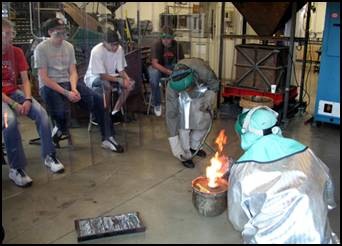
Dr. Sam Ramrattan and Adil Abdelwahab, an IME graduate student, demonstrate how to pour molten aluminum into sand castings. After the demo, the high school students, who are seated behind the protective barrier, donned safety apparel and made their own sand castings.

WMU has had a casting metal program in various engineering curricula since the college opened over 100 years ago. Its most recent accreditation began in 1992 when Ramrattan joined the faculty. “Our goal is to produce hands-on engineers as an integral part of what we do in manufacturing engineering programs,” he said.

Metal casting is currently a program option in the industrial, manufacturing, graphics, and engineering management programs.

clip_image006

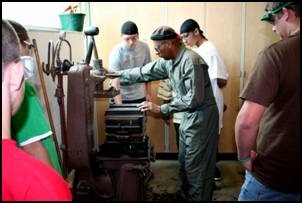
Dr. Sam Ramrattan demonstrates the mold making process

Tuesday, July 11, 2006

IME Advisory Boards Meet; Local SME Adds $20,000 to Roscoe Douglas Fund

This spring, the IME’s four advisory boards met to discuss the future education of engineers. The boards, which include representatives from several corporations and organizations and IME faculty, discussed future trends in the workplace and assessed how to meet the changing educational and experiential needs of IME.

Groups re-presenting IME’s four under-grad-uate programs – manufacturing (MFT), engineer-ing graphics (EGR), engineering management (UEM), and industrial engineering (IE) – held meetings following the 38th Conference on Senior Engineering Design Projects (SEDP).

According to Dr. Mitchel Keil, the IME professor who chairs the EGR board, many members of the boards are WMU alums of the programs for which they now serve as advisors.

The boards considered current changes being suggested to the core curriculum to provide a common first-year program for all incoming freshmen engineering students and to organize them into cohorts. Under consideration also were the need for co-op experiences and international internships and potential changes in foreign language and calculus requirements.

Members also weighed the pros and cons of minors and options, the call to limit programs to 124 credit hours, and the inclusion of a 4 +1 program to allow a student to earn bachelor’s and master’s degrees in five years. They also reviewed enhancing the curriculum with topics such as product data management (PDM) and failure mode effects and analysis (FMEA).

IME professor Fred Sitkins said the MFT board agreed that the goal of education is changing from those proficient in manufacturing engineering to those proficient in manufacturing processes. “They want to hire those who understand the broad processes,” he said

Referencing the SEDP Conference that preceded the advisory meetings, IME professor Dr. Bob White said the IE Board agreed that “the IE projects were the best group of IE projects they’d seen at SEDP.”

SME Scholarship Funds Presented to Foundation

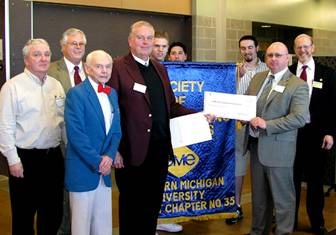
SME members pose with a $20,000 check donated to SME Foundation for scholarships. Left to right are Ron Jones, Dave Steffans, Bruce Burrows, Mitchel Keil, Erik Korbecki, Brian Cervin, Ryan Miller, SME Foundation Representative Bart Aslon, and IME Chair Paul Engelmann

SME members pose with a $20,000 check donated to SME Foundation for scholarships. Left to right are Ron Jones, Dave Steffans, Bruce Burrows, Mitchel Keil, Erik Korbecki, Brian Cervin, Ryan Miller, SME Foundation Representative Bart Aslon, and IME Chair Paul Engelmann

Kalamazoo Chapter 116 of the Society of Manufacturing Engineers (SME) presented a check for $20,000 to the SME Foundation for Roscoe Douglas Scholarships (RDS). Ron Aslon, representing the SME Foundation, accepted the check and thanked the local organization.

In the past, Chapter 116 has supported RDS, which have been awarded by SME to full-time students who maintained a 3.0 GPA in either a manufacturing engineering or a technology program and who attended one of six approved Michigan institutions.

WMU’s most recent RDS recipients are Brian Cervin, Eric Korbecki, and Joshua Weise.

Next year, the IME department’s scholarship and publicity committee will determine how the RDS funds are distributed. Also all future RDS recipients must be WMU students.

The next official advisory board meetings are set for April 2007.