Friday, January 12, 2007

FEF Conference Offers Students Opportunity to Network in Metal Casting Industry

Six IME students attended the 2006 Foundry Educational Foundation College Industry Conference (FEF CIC) held last November with Dr. Sam Ramrattan, a specialist in material and process and the WMU FEF Key Professor, and Dr. Tim Greene, dean of WMU’s College of Engineering and Applied Sciences.

The 59-year-old conference is held annually in Chicago. The current FEF President is Bill Barrett, president and CEO of Neenah Foundry Co , who was inducted into the CEAS Alumni Excellence Academy in 2006.

The WMU student delegates were Adam Bell (ME), Kyle Manduch (EGR), Ryan Miller (MFT), Charles Ponscheck (MFT), Matthew Rutledge (EGR), and Scott Seckel (MFT).

Ramrattan described the conference as “an exciting event” that actively reaches out to engineering colleges and universities in North America. WMU is one of only 25 in the world to be accredited by this foundation.

Seckel said the conference gave student delegates the opportunity to interact with representatives of companies in the metal casting industry. “There were as many as six delegates from numerous colleges from across the country,” he said. “The information section is structured to connect students to potential employers.”

According to Manduch, an EGR senior, the group spent the first night meeting representatives from a number of companies. “It was a great opportunity not only to meet companies, but to network with others in the metal casting industry,” he said.  “It was a fun night, where we [he and Miller] went out and about in downtown Chicago. We ended up at the Signature Room on the top of the Hancock Center, where we enjoyed the beautiful night lights of Chicago while networking with Honda representatives.” 
A special feature of this year’s event was a fund-raising silent auction held at the awards banquet in which industry leaders competed to purchase Super Bowl XL football tickets. Proceeds from the auction will benefit students in metal casting programs.

Students attend the conference for the opportunity to win scholarships and to network with representatives from industry. “Companies attend this conference to help promote their names and to look at students who could potentially become part of their teams,” Seckel said.
clip_image002

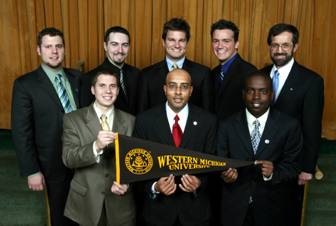
Representing WMU at the 2006 FEF CIC: front row (l-r) Scott Seckel, Dr. Sam Ramrattan, and Adam Bell and back row (l-r) Charles Ponscheck, Ryan Miller, Kyle Manduch, Matt Rutledge, and Dr. Tim Greene

The conference presentations included an update of current work being done by a recent engineering graduate, a review of changes in the industry from an engineer who has spent his life in the metal casting field, and an overview of positions presently available to graduates in the metal casting field. “The last discussion was primarily about the new wave of technology and the future of casting technology,” Manduch said. “After the conferences, we were able to tour the night life of Chicago.”

Manduch described the conference experience as a “very beneficial” one that seemed like a “family reunion” and offered lifelong learning experiences the students would be unable to get in a class.  “It was like a giant metal-casting family,” he said. “Everyone knew everyone else, and I learned stuff I will take with me for the rest of my life.” 

Describing his conference experience as “very valuable,” Seckel said he had his first “very tasty” dinner interview, which led to a second interview and a job offer that he accepted as the Casting Engineering Manager at Blackhawk Foundry in Davenport, IA. “The opportunities presented to students like me are the result of attending industry conferences like this,” he said.

Monday, November 20, 2006

EGR Seniors Present “Power Copies” Project at COE Workshop

Three IME students – all engineering graphics and design technology program (EGR) seniors who graduate in December – accepted an invitation to make a presentation at the CATIA Operators Exchange (COE) Automotive Industry Workshop Technical Conference held last month in Dearborn.

clip_image002

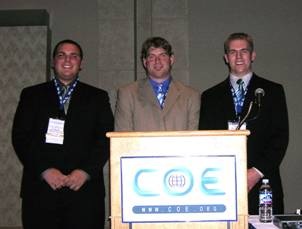
IME students (L–R) Greg Giudici, Josh Brien, and Eric Korbecki
were the only students invited to present at COE conference

In “Putting the Power in Power Copies,” Eric Korbecki, Greg Giudici, and Josh Brien provided an overview of work they did last summer while interning at Johnson Controls, Inc. (JCI). “Our presentation dealt with Knowledge-based Engineering and a form of engineering design in CATIA V5 called power copies,” Korbecki said.

Brien, who interned at the JCI Holland location, explained that “a power copy is a copy of a feature that can be used on a model.”

According to Giudici, who interned at the JCI Plymouth location, the students created power copies as part of the Knowledge-based Engineering (KBE) team at JCI. “Creating power copies saves designers time when they need to use one of the common features,” he said. “Instead of modelling the feature in their part, they simply use the power copy feature.”

For the COE presentation, the students described the processes of creating a power copy, imbedding knowledge into it, and implementing it. Combined with Knowledgeware and engineering rules, a model can be morphed and adapted to its environment. “It’s taking CATIA to the next level,” Giudici said.

According to Korbecki, the students’ design of the workbenches and the applications used were relatively new and advanced. “We considered this an opportunity to show the capabilities of the Knowledgeware workbench in CATIA for rapid and identical creation of common, complex features in a 3D solid model,” he said.

Many concurrent presentations of technical material based on Dassault Systems’ software programs were offered at the workshop. The students’ presentation was part of the Product Design Category at the Beginner, Intermediate level.

“We were the only students to present at this conference,” Korbecki said. “It was a great way to showcase the skills and knowledge we’ve received from Western and from JCI.”

The group credited JCI mentor and KBE team leader Jeff Roark for encouraging the students to speak at the conference. They also expressed their appreciation to JCI co-workers and WMU alumni Dave Burke and Anthony Pulcini for their technical support during the internship.

clip_image004

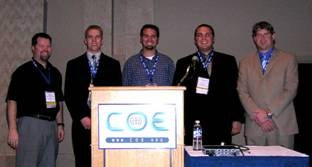
Attending COE (L-R): JCI’s Jeff Roark, Eric Korbecki,
JCI’s Dave Burke, Greg Giudici, and Josh Brien

In addition to making the presentation, the students also attended presentations on knowledge assets, which is similar to power copies, and product data management (PDM), a virtual data base system. They also participated in a hands-on course for developing 3D solid models at a substantially faster and more efficient rate.

“It was good to get out and see what’s going on in industry,” Brien said.

Tuesday, August 29, 2006

IME Group Enjoys ANTEC’s Futuristic Perspective of Plastics

Last May, 11 IME professors, graduate assistants, and students joined up to 5,000 plastics enthusiasts from all over the world at the Annual Technical Conference (ANTEC) sponsored by the Society of Plastics Engineers (SPE) and held in Charlotte, NC.

Described on the SPE Web site as “the leading technical forum for providing cutting-edge technological issues and information pertinent to the needs of the plastics industry,” ANTEC annually offers peer-reviewed technical papers providing plastics professionals “unique inside access to proprietary research and findings.”

IME Chair Dr. Paul Engelmann called ANTEC “the major technical event for plastics.” He said that more than 600 papers were presented in 25 concurrent sessions that ran from 8 a.m. to 6 p.m. for three days and for most of a fourth. “The Society’s best international papers for the year are presented at this set of meetings,” he said.

Accompanying Engelmann were IE Ph.D. graduate assistants Kurt Hayden and Jason Trahan; Jay Shoemaker, adjunct assistant professor from Moldflow; and Brian Sather, a master’s candidate graduate assistant in the plastics manufacturing program.

The six undergraduate students who attended – Brian Cervin (MFT), Andrew Dowdy (EGR), Greg Giudici (EGR), John Graver (MFT), Eric Korbecki (EGR), and Ryan Miller (MFT) – served as ushers at technical sessions in lieu of registration fees. The undergraduate students’ travel arrangements were made by Hayden, who also mentored the students throughout the conference.

Funds to send the students to the conference were provided by a grant from the Alcoa Foundation, through EPC/Alcoa in Mattawan. The grant supports the professional development and global awareness of students in engineering technology programs. The students wrote formal proposals for travel support to the conference as well as trip reports on their ANTEC activities and professional development upon their return.

IME Assistant Professor Dr. Betsy Aller is principal investigator of the grant and Professor Dr. Larry Mallak is co-PI. Aller has applied for another EPC/Alcoa grant for the same purpose; it is currently in the process of being approved at the national level.

Trahan presented a paper titled "Why troubleshoot when you can prevent? A Bayesian network approach," which he described as his ”biggest event” of the conference. “I had good turnout for the presentation and good conversations afterwards on the topic,” he said.

In addition to the papers, the event also included a series of special international panels and vendor displays.

The attendees were particularly impressed by the panel discussions, especially one titled “The Plastics Industry in India: The Next Frontier.” Engelmann said, “It furthered my understanding of the maturity of that industry in India as compared to in the US.” Engelmann was also impressed by presentations on nanotechnology, which could revolutionize the way that reinforcing elements are used in plastics.

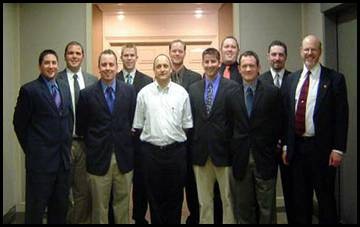
Attending ANTEC: (FRONT L-R) Brian Cervin, Andrew Dowdy, Jay Shoemaker, Brian Sather, Kurt Hayden, and Dr. Paul Engelmann. (BACK L-R) Greg Giudici, Eric Korbecki, Jason Trahan, John Graver, and Ryan Miller.

Attending ANTEC: (FRONT L-R) Brian Cervin, Andrew Dowdy, Jay Shoemaker, Brian Sather, Kurt Hayden, and Dr. Paul Engelmann. (BACK L-R) Greg Giudici, Eric Korbecki, Jason Trahan, John Graver, and Ryan Miller.

The IME students attending ANTEC cited presentations on globalization in the plastics industry and an interactive session on injection molding as among the most interesting and useful sessions. They also noted that many sessions helped them see the relevance of and connections between materials they’d learned in classes.

Several attendees mentioned “Student Recognition Night,” sponsored by several companies including Moldflow, as a fun social activity. Students played arcade games, networked with professionals and attendees from other universities, and received free SolidWorks software.

In their trip reports, students said that the opportunity to travel and interact with IME professors and graduate students was excellent, as was networking with other students and professionals at ANTEC. “After participating in the ANTEC conference, I see that there are so many different directions that the plastics industry has to offer,” Cervin said. “Only at a convention of this magnitude can you appreciate [all these aspects].”

Several students stated they were inspired to present a professional paper at a future ANTEC conference. And all echoed Dowdy’s “Thank you for the continued support and development of engineering students!”

With support from the new EPC/Alcoa grant, IME plans to send several undergraduate students to ANTEC 2007, with the goal of presenting at least one technical paper.